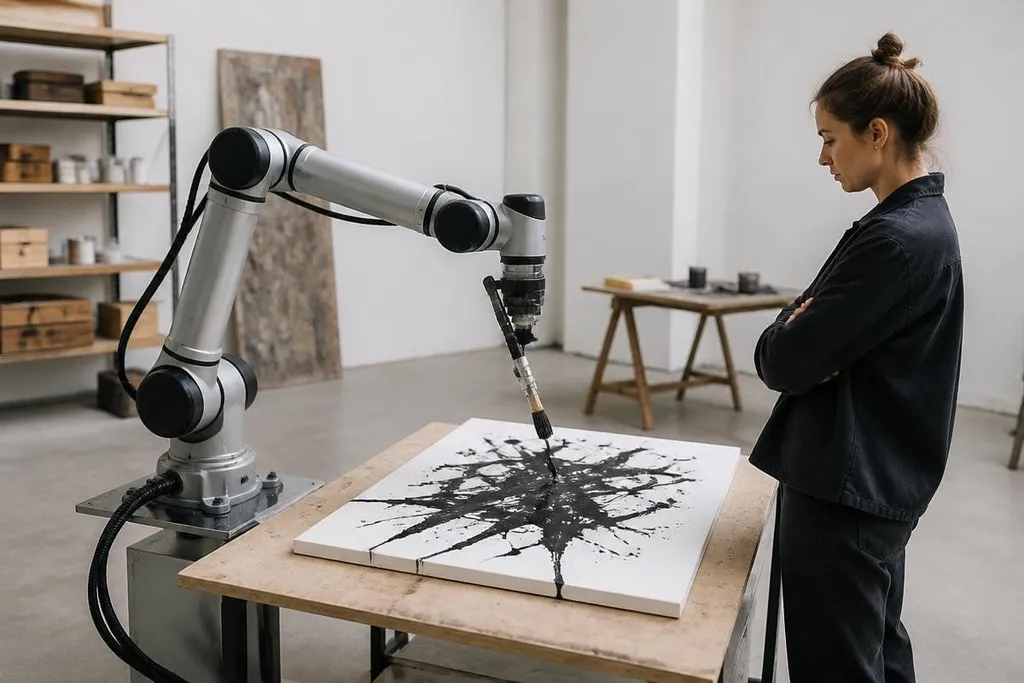
A robot can move a brush, cut a shape, or place objects on a table. The harder question is who sets the goal, checks the result, and pays for the work. For robot artists, the next stage will depend more on useful jobs than on making machines look human.
- Robots can repeat a physical action with steady timing.
- Human direction still sets the subject, rules, and final choice.
- The first useful market may be custom objects, not gallery pieces.
What a robot artist can do
A robot artist is a machine that turns instructions into a physical result. It may use a camera to inspect a surface, an arm to move a tool, and a gripper to hold paper, wood, clay, or paint equipment.
That setup gives the machine a clear strength: repeatable motion. Its arm can place the same mark in a chosen position many times, then change the pattern when software sends a new path. The work can be measured by position, speed, pressure, and tool angle.
The result still depends on the material. Paint spreads. Clay bends under pressure. A cutting tool wears down. A camera may also miss a change in color or texture that a person would notice at the workbench.
Those limits matter because art is physical work as well as image making. A digital picture can be copied with little change. A painted panel, carved part, or shaped piece carries the marks left by the tool and the material.
The human role will change
People will remain responsible for the parts that are hard to reduce to a set of machine instructions. They may choose a subject, set limits for the process, reject weak results, or change the plan after seeing the first piece.
That makes the robot closer to a programmable studio tool than an independent artist. The person supplies purpose and judgment. The robot handles motion that may be tiring, repetitive, or hard to repeat by hand.
This split could support work that needs many custom pieces. A designer might create one base pattern, then alter the path for each customer.
A museum, school, or workshop could also use the machine to teach tool control, geometry, and basic automation through a visible physical result.
That teaching use gives robot art another market. Robot24.com robotics coverage can place claims about paid classes or commissions beside the robot’s price, task, and buyer. The next section looks at which work can pay for the machine.
Where the money may be
The first buyers may care less about a robot’s “style” than about the job it can complete. Custom signs, patterned panels, educational kits, and small runs of physical objects all give the machine a clear task and a way to judge the result.
A gallery sale is harder to measure. Buyers may ask who made the work, what role the person had, and if the same piece can be made again. Those questions affect price, credit, and ownership.
A machine that repeats a pattern may be useful to a workshop, but repetition alone won't make the result worth more. The value may come from the design, the material, the story of the process, or the buyer’s wish for a one-off object.
I'd judge a robot artist by the quality of the job around it, not by a human-like arm or a polished demo video.
What remains unproven
The hard part is deciding if a robot made the work in a meaningful sense. A system may follow a fixed path, choose from several paths, or react to camera input. Those are different levels of control, and buyers need to know which one they are paying for.
Cost will shape the answer too. A machine needs the robot arm, tool, sensors, software, safety equipment, floor space, and a person who can fix errors. Without a clear gain in output or quality, a hand tool may remain the better choice for a small studio.
The strongest claims will need records of the process. A useful report should show the input, the robot’s actions, the changes made by a person, and the final object. A short clip of a brush moving across a canvas leaves too much out.
A practical buying check
Before you treat a robot art project as a working tool, check these points:
- Name the job: Write down the object, material, size, and finish you need.
- Check the path: Ask how the robot plans motion and how a person can change it.
- Price the full setup: Include tools, sensors, software, safety gear, training, and repairs.
- Watch a full run: Look for pauses, resets, camera errors, and human edits.
- Set authorship rules: Record who made the design and who approved the final piece.
Those checks also give artists a fair way to use automation without hiding the machine’s role. The work can carry a person’s idea while showing exactly where the robot acted.
The next useful robot artist will probably be the one that completes a clear physical job, records how it worked, and leaves the human decision visible.